Saturday, July 11, 2015

One Mannequin is More Than Enough

Yesterday on Friday, 10 July, at approximately 9:20 am, I hopped on a train heading south-west to Bath, England. All of you fellow Austenites should know where this is going.

Bath is a little over 100 miles west of London, it took me about 2 1/2 hours to reach it by train.


Excerpt from map of Bath I purchased at the train stop, showing my main haunts. Note the Royal Crescent (purple half-circle), The Circus (purple circle), Jane Austen Center (on Gay Street), and Assembly Rooms (Fashion Museum) (purple "t" to the right of The Circus), the Georgian Garden (green square to the lower left of The Circus, and the Gravel Walk (below the Georgian Garden).

Jane Austen is referred to as Bath's most famous resident, visiting in 1797 and 1799, respectively, and living here from 1801 - 1806, and setting two of her novels, Northanger Abbey and Persuasion, in the city as well; all of her work mentions Bath. At the time, Bath was a famous resort town in England, much like the Las Vegas of our own day. It was a place to see and be seen, as well as a place for the sick or infirm to try and find healing in the hot springs of the baths, which dated back to Roman times.

Bath affected Jane's writings, and her own personal experiences likewise reflect back on the city. In Northanger Abbey, one of Austen's earlier novels, Catherine Morland is excited and eager to see the city, exclaiming, 'Oh! Who can ever be tired of Bath?' In Persuasion, her last finished work, written nine years after leaving Bath, the city is full of shallow, fashion-conscious people, and Ann Elliot finds the city constraining.

Be that as it may, the city undoubtedly held a place of great importance in her life and in her work, and it's not too difficult to imagine why:

House on The Circus

The Circus, northern portion

Row of houses on Lansdown Road, across from Bennett Street. Bath is built on a hillside so most streets look like this.

The Royal Crescent, view from across Royal Victoria Park.

Heading east on the Gravel Walk

A garden gate on the Gravel Walk

View from the Georgian Garden

A small side-street

Bath Abbey

Bath is an absolutely breathtaking city, there is nothing like it around Cleveland, and it must have been something to a country girl like Jane Austen, when she first arrived.

I went to the Jane Austen Centre, an exhibition focusing on the five years of Austen's life spent living in the city. It's located at No. 40 Gay Street, a house very similar to the one Jane lived in - No. 25 - for a few months following her father's death in 1805. They were both built in the Georgian style between 1735 and 1760 by Bath-based father-son architects John Wood the Elder and John Wood the Younger. The houses are alike in design, although this house had an extension added in the 20th century covering all of the garden, where the permanent exhibition is located.

Looking south down Gay Street. No. 40 is on the left.

The Jane Austen Centre located at No. 40 Gay Street. The man on the left is a costumed interpreter, the woman on the right is a fake plastic statue.

The house is definitely authentic, as it's all very tight and cozy, or what Americans would call cramped  and small. The gift shop/ticket window is through the front door to the right, then it's back into the entryway and up the stairs, first room first landing. This room would have been the upstairs ladies' parlor, where the women of the house would drink tea, write letters, sew, and entertain lady (and maybe even *gasp* gentleman) visitors.

In this room were benches for modern visitors to wait to be admitted by a costumed interpreter to an adjacent room with more benches, where the guide would give a brief background about Jane's life here in Bath before sending us down a second flight of stairs into the exhibit itself.

The first room presented a little timeline on one wall pertaining to all the important events of the day, such as coronations of kings, births of poets and authors, with Austen's own personal timeline interspersed. On the other wall were objects and text (there they are again!) acquainting viewers with the people, customs, and general way of life at the turn of the eighteenth century.

Then followed a darkened room playing a 15-minute video about Austen's life in Bath, narrated by none other than Adrian Lukis, aka George Wickham of the 1995 BBC version of Pride and Prejudice.

Adrian Lukis as Mr. Wickham. He looked a bit older in the video.

After we were done being distracted by trying to figure out who the narrator played that one time (I helpfully reminded one woman who only remembered it started with a "W"), we went on into a long gallery highlighting different aspects of Austen's life in Bath, punctuated by quotes from her letters to her sister, Cassandra, or excerpts from her novels. These ranged from her shopping activities, to socializing at dances and concerts, to clothing, and to tea-time, at which point they tried to pass these things off as biscuits:

Pictured: Not biscuits.

I was most intrigued by this:


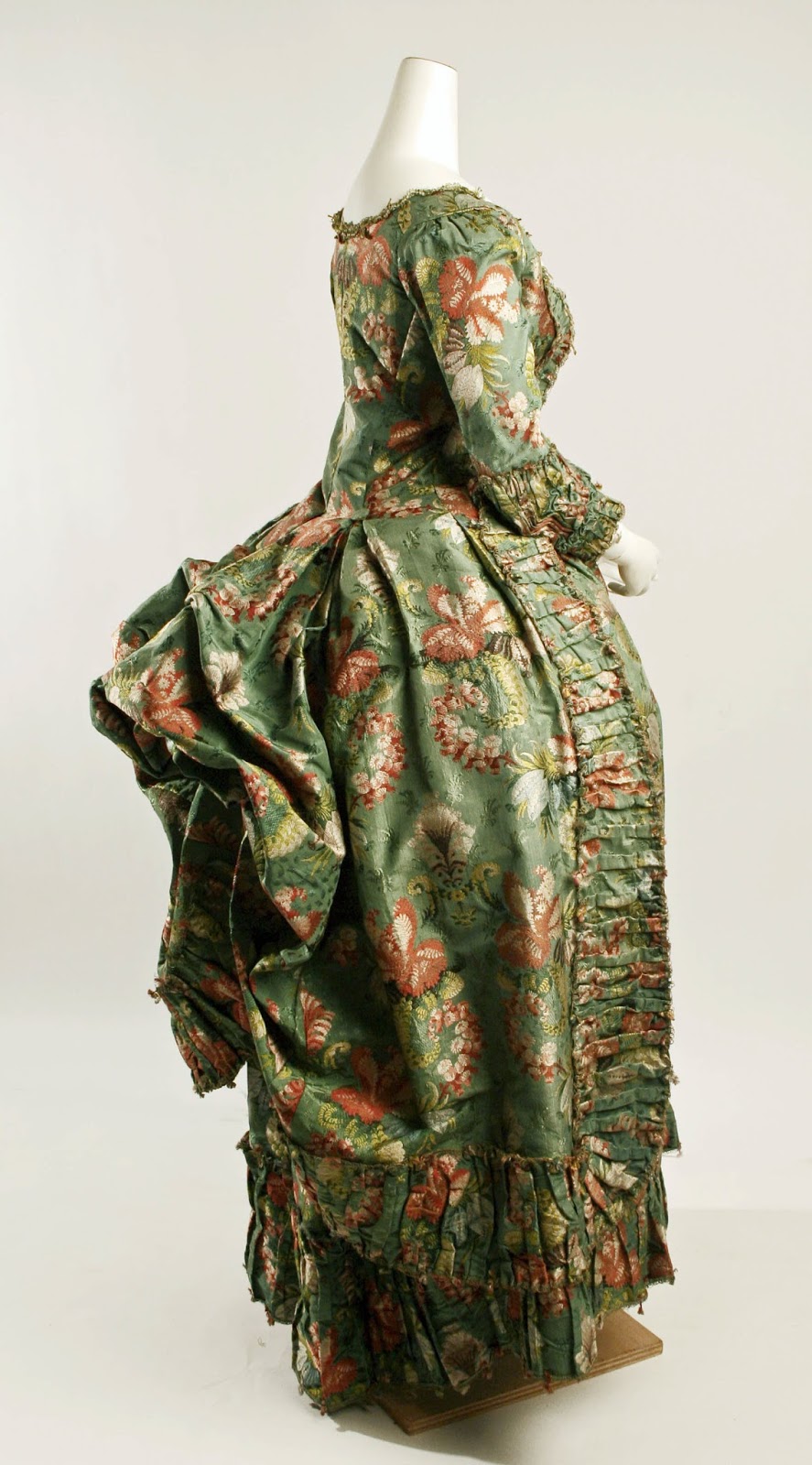
An original dress dating from the Regency era, it came to Bath costume maker Sue Seals in 2002, entirely in pieces. The story was displayed beside the dress on an easel, complete with photographs:


It's a lovely dress, and I probably got in everyone's way by hovering around it so much they gave up trying to take its picture.

Everything had to be made by hand, as the sewing machine in it's modern form wouldn't be practical for another five decades or so. Lace was purchased from local shops.

This dress has an interesting "bib" like front to it consisting of two layers, the triangle with applied self-trim and lace lower and the split/ruffled upper.


The train present on this dress lead Sue Seals to speculate to its intention for a wedding dress, which is possible. However, trains were not uncommon on the ball gowns of the time, and the wealthy would often wear trains more frequently, as they were a status symbol.

This evening dress shows a train, and the upper portion of the bodice and sleeves are decorated with ruffles, not unlike the stripped Regency dress.

The fabric was so fine and sheer it was transparent.

The bottom consisted of rows of ruffles, the front panel did not.


This lovely dress looks remarkably similar to the one currently in the Jane Austen Centre.

Admittedly I lingered over the costumes displayed more than anything else, there was also a shop front depicting lace, gloves, and other accessories, as well as an area for dressing up in the styles of clothing worn (I did that before it was cool) and a writing desk to try ones hand (pun) at using a bit-pen and ink. The final room contained references and images from Austen's works depicted in film and on the television (yes Colin Firth's Darcy was there) and the only authentic life-size waxwork of Jane Austen herself.

Ahh! 
(I've never liked waxworks.)

The third floor hosts the tearoom, when I got to answer to the hostess' lovely question of "How many?" with "Just me." 


I munched on "Lady Catherine's Proper Tea," which consisted of two scones, one fruit one plain, served with clotted cream, two kinds of jam, and butter, plus a cream tea of your choice. I chose the Darjeeling.


They bring out the tea-tray, which is very fancy and all, a teapot (right) with the actual tea in it, then a pot of hot water (left) to dilute the tea? (What?) Then a little strainer-thingy (right, front of teapot), then a pot of cream (far left, above the teacup). I felt just like Jane, until I slopped the tea all over the strainer and ended up with a puddle in my saucer, then forgot I put the sugar cubes in advance (because everyone knows unsweetened tea is gross) and freaked out when I thought something was in my teacup. But in the end I made it:


Only I forgot to use the dilution-water and that Darjeeling was REALLY STRONG.
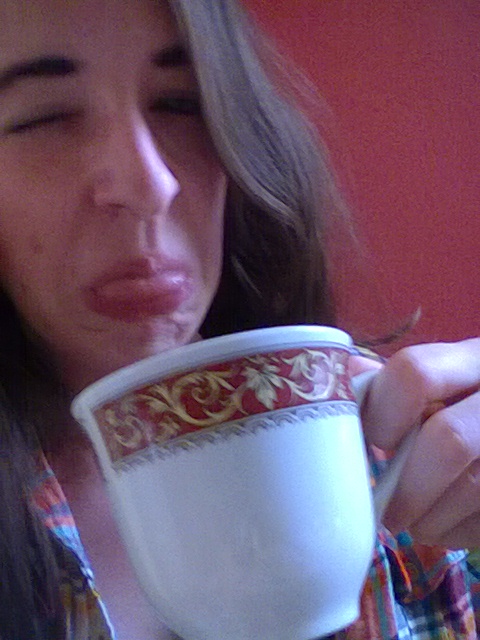
Do not forget to dilute your Darjeeling.

After I had tarried for a reasonable amount of time in this manner, I went out and headed up to another point of interest: the Assembly Rooms, also playing host to the Fashion Museum, Bath.

One of Bath's finest Georgian buildings, the Assembly Rooms was designed for fashionable gatherings. Built from 1769 to 1771, the Assembly Rooms was the third Assembly Rooms in Bath, however, they were seen as being old-fashioned and too small for the fast growing city.

The exterior of the building is rather plain (I walked right by it), but the inside is exceptionally grand, especially the Ball Room, the largest eighteenth-century space in Bath.


So too the Great Octagon and the Tea Room do not disappoint:

The Great Octagon

The Tea Room

Originally known as the Museum of Costume, today's Fashion Museum came to the Assembly Rooms in 1963. It was founded by the writer, scholar, costume designer and collector of historic costumes Doris Langley Moore (1902-1989), who first began collecting in the 1920's.

In 2007 the museum became the Fashion Museum, and clothing worn by fashionable men and women throughout the past 350 years is displayed in its galleries, the total number of pieces in its collection numbering over 80,000. 

The oldest of these are elaborate gloves from the early 1600's, which were given as gifts or as marks of affection (Fun Fact: It was not important whether or not the gloves fit - often times they did not - all that really mattered was who they were from and how fancy they looked. And they looked FANCY.)


The Fashion Museum also seeks to keep itself current, with the Dress of the Year scheme: "each year the museum asks a fashion expert to choose a significant look shown on the catwalk during the international fashion weeks, and the ensemble selected is gifted to the Dress of the Year Collection." (Taken from The Authorised Guide: The Assembly Rooms, Bath, page 19.)

Unfortunately such a scheme means you will be forced to endure this:

The 2014 winner, Gareth Pugh. I think we are all losers here.

But we also get to enjoy this: 

Sarah Burton for Alexander McQueen.

So it's not all bad.

Full discloser: I really have little to no use for clothing post-WWI. I will tolerate the 20's. Other than that, probably not.

No.

I took a lot of pictures. A LOT of pictures. They will come in handy while I explain the layout of the museum.


The Museum is arranged chronologically, beginning with the Georgians (the time period from 1714-1830, when all the Kings were named George).


Note this dress in the front center and the one to the left of it are missing their stomachers, a detachable decorative piece often made up of ribbons, embroidery, or self-ruffles.

This dress from about 1750 has the stomacher intact.

The display goes through some fashionable day wear, night wear, and the ever-popular court wear, as well as gentleman's dress.


The Georgians wrapped up with a few pieces from what is also called the Regency:


A selection of uniforms:


And several transitional dresses, leading from the high-waisted styles of the 1810's to the soft, Romantic styles of the late 1820's and 30's.


Suddenly, one is confronted with this:


And rounding the corner is a whole slew of undergarments, dresses, hats, and the like for playing dress-up. They are not messing around, either, these are decent, quality reproductions that really give people the feel for wearing and moving in the quintessential "Victorian" dress.


There's even a little area where one can have a staged picture in full costume:


People seemed to enjoy it too, taking the time to stop walking and viewing to try on corsets and hoop skirts, garments and hats.

People having fun trying on outfits

I was completely taken aback at the way they displayed their Victorian costumes, however. Expecting a display similar to the one used with the Georgians, instead I encountered this:


Fashion plates from the 1800's to early 1900's adorn the walls, and nestled into the four walls around the square room were vignettes of the costumes held, with descriptions of the decade portrayed and overarching themes present.


 Perhaps the most intriguing is the inclusion of the boxes, stacks and stacks of them, showing the collection in it's "Costume Shop" form. If you recall, on Thursday I went into the Museum of London's Costume Shop located in the basement, it's boxes hidden away from the public view. Here, they are out for the visitor to see, and perhaps get a closer look into the inner workings and scope of the Museum's collections.

The dresses themselves were, of course, stunning.


And at the end of the Victorian and early Edwardian eras visitors were invited to share their thoughts with the Museum via the Inspirations Wall:


And try their hand at fashion design using the Drawings Wall: 


But wait, there's more!

In order to leave the Museum, first you must pass through this:

Ahhhhhh!!!!!

Yes, modern fashion must have its due, and you must pass through a hallway of mannequins to view it.

*Gulp*

That's not entirely fair, there were a few I enjoyed:

Christian Dior, 1950

Peter Russell, c. 1934

Please note how none of them were on the humanoid mannequins.

Exhibit A.


The Fashion Museum used three very different ways in which to display the three time periods making up its collections, and very fittingly too: the traditional, stately manner for the gradual procession of Georgian attire, the snapshots of styles confined to very specific decades in Victorian dress, and the rapid progression of fads and fashions all piled on in the long hallway-come-catwalk that is 20th and 21st century clothing, all culminating in the Dress of the Year.

No.

It made for a very exciting, interesting experience.

I visited two very different museums, and both provided insights into the creating of displays, utilization of space, and ways of engaging with the audience. I learned a lot, and came away with perhaps the most valuable lesson of them all: One mannequin is more than enough.


Information taken from:

Visitormaps: Bath, purchased at the train station shop
The Jane Austen Centre pamphlet, picked up at the Jane Austen Centre
Jane Austen's Bath: A Biography & Walking Tour of the City, purchased at the Jane Austen Centre
The Authorised Guide: The Assembly Rooms, Bath, purchased at the Assembly Rooms store




Friday, July 10, 2015

A Tale of Two Displays

On Thursday our class went over two readings on the nature of London and the Londoner within it, both written by Virginia Woolf: Mrs. Dalloway (1925), and Street Haunting: A London Adventure (1930), in the stream-of-conscious style, the former from the mind of Mrs. Dalloway, the second from Ms. Woolf herself.

Our discussions focused on the accuracy of  such narratives, and what they inform the reader - both casual and historian - about the nature of the city, its people, and the author. The overall idea was this (my own interjections in italics): That it is useful as a first person narrative (and much more interesting stylistically then a straight-forward rendition: "With no thought of buying, the eye is sportive and generous; it creates; it adorns; it enhances . . . . [L]et us indulge ourselves at the antique jewellers, among the trays of rings and the hanging necklaces. Let us choose those pearls, for example, and then imagine how, if we put them on, life would be changed. It becomes instantly between two and three in the morning; the lamps are burning very white in the deserted streets of Mayfair . . . ."(from Street Haunting), over "There was an antique shop on --- and --- intersection named --- and it sold pearls."), and it offers insights into the way the city was and the way the people were, but it must also be taken with a grain of salt, for it is not impartial and is filtered through a specific person's specific view (but then again, isn't everything? "Read me anything but history, for history must be false." So quoth Sir Robert Walpole, and quite accurately, too. Actions are clear enough, but motives? Motives are unknowable to all but the one motivated.)
We then briefly went over the importance of objects vs. narratives, and which, if either, is of the greatest historical significance? Objects, because they provide a concrete, physical link to the past, or narratives, because they provide an intimate look into the minds and lives of the people living at the time? It should come as no surprise that the answer was "It's best if both are together." An object says a thousand words, (a million words could lead to a million different people forming a million different interpretations of one object), but several words can lead to a deeper understanding of how said object was viewed and held in great esteem (or none at all) by its original owners.

An excellent example is the engagement ring given by John Keats to Fanny Brawne, held at Keats House in Hampstead, North London.

Image painfully obtained from 

It's a beautiful piece, and would capture many a person's interest sitting in a case, with a little card next to it reading "Engagement ring given to Fanny Brawne by John Keats in early 1820." But what if we were also able to see a progression of love letters written by Keats to Fanny leading up to the event? What if we were able to read in the poet's own words his love for this woman, to whom he was ready to make the ultimate commitment?

Postmark: Newport, July 3, 1819
Shanklin, Isle of Wight, Thursday
My dearest Lady - . . . . The morning is the only proper time for me to write to a beautiful Girl whom I love so much: for at night, when the lonely day has closed, and the lonely, silent, unmusical Chamber is waiting to receive me as into a Sepulchre [a small room or monument where a dead person is laid or buried], then believe me my passion gets entirely the sway, then I would not have you see those Rhapsodies which I once thought it impossible I should ever give way to, and which I have often laughed at in another, for fear you should [think me] either too unhappy or perhaps a little mad. . . ." (Taken from http://www.poets.org/poetsorg/text/selected-love-letters-fanny-brawne)
The force of those words is now behind the ring, and we are afforded a tiny peak into the heart and mind of a man who loved a woman back in 1819, and just so happened to have the ability to write a very lovely letter to her on the subject.
Continuing on, our group was in the enviable situation of having TWO museum lessons in one day. The first was a visit down into the bowels of the Museum (aka the staff-only basement) and from thence to the Costume Shop. Needless to say I was completely in raptures, even though most of the collection very naturally spends most of its time in special preservative boxes. It was apparent from the get-go that Timothy Long, Curator of Fashion & Decorative Arts, was as knowledgeable and enthusiastic about his work as anyone could ever hope to be (and this isn't just me gushing, several of my friends/classmates commented as much after the fact).
Mr. Long gave us his brief history, then launched into his true passion: Menswear. Unfortunately, in the world of fashion and costuming men's wear often gets the short end of the stick.
This:


Is never going to be as interesting to the general viewing public as this:


Sorry, fellas. There is also the general issue of there being far fewer men's clothing floating about than women's, there are several guesses for this, some scholarly, some mine (those are the common sense ones), being, in no particular order: Men's clothes experienced more wear and tear, men's clothes didn't change in fashion as quickly as women's and therefore were worn more often and for a longer period of time (see above), men don't take as good of care of their clothes as women do (hence the above), men didn't buy as many clothes, men didn't bother storing their clothes or if they did, they didn't do it nearly as well as the lady-folk. Etc. etc., insert your own theory here.

All this to say, that Mr. Long was given a chance to work on the Museum of London's now-ended Sherlock Holmes exhibit: http://www.visitlondon.com/things-to-do/event/35655157-sherlock-holmes-at-the-museum-of-london. He was in charge of the clothing, which at first seemed fairly straightforward: deerstalker (the hat), "costumes" (Holmes was the master of disguise) . . . but then he started digging deeper, and that's when thing really got . . .  elementary. (Forgive me, dear reader, I could not resist.)

Sir Arthur Conan Doyle wrote about what was true, that is, he didn't make the character of Holmes some sort of super-human, with super-human powers and gadgets to aid him in his work. Holmes worked with what was available at the time of the novels, in the late Victorian and very early Edwardian eras. As Mr. Long began reading the original books and digging into the characters and scenarios, he began seeing clues, clues that would have been quickly picked up on by the readers of his day, but maybe not so obvious to the modern viewers of the Sherlock Holmes exhibit.

For example, the famous deerstalker. You have all seen this before:


This hat was worn when hunting, or stalking deer. Fun Fact: Sherlock Holmes never hunted. Why, then, was he wearing a hat specifically intended for hunting? Ah, but he is! Holmes dons the hat because he is about to begin the hunt . . . for the criminal! *impressed nodding all around*

Clothing was used to describe people, and when found alone could be used to provide clues as to who to look for, and what that person had been up to. 

Mr. Long showed us two specimens, each like one of the hats below (albeit much older):


This, ladies and gentlemen, is a top hat. A collapsible top-hat. Holmes, and those reading his story, would have known instantly what this is for, and why it's significant. There was only one place in which a collapsible top-hat was worn, only one in which it was necessary. Any one want to guess?

The opera. Top-hats were forbidden at the opera, (too much stress for the coat-check guy - hundreds of men, hundreds of identical black top-hats . . . you see the problem), but the top-hat was an indispensable piece of the properly-dressed gentleman's wardrobe. You simply could not be seen in public - at the opera, no less - without a top-hat. So the collapsible top-hat was invented, so a gentleman could arrive in style, collapse his hat, and store it under his seat. Then, when the opera ended, simply pop it back open, and exit in style once more.

Footprints also feature prominently in Sherlock lore, and Mr. Long showed us an interesting example of a sturdy ladies' boot. There was nothing particularly special about the boot, save one detail: a removable screw in the heel. When we failed to guess at the correct answer (or Mr. Long was done amusing himself, one or the other), he revealed it was for attaching ice-skates. The blade would be screwed into place, then strapped down with ties over the foot portion of the boot.


A footprint with a screw in the heel would have been just the sort of clue Holmes would've loved to find. The Museum began capitalizing on these interesting details to flesh out the exhibit, including making prints of shoes in the collection like the skating-shoe:

Note the tiny indent in the heel left by the screw. Image used with permission of Timothy Long.

The Museum was also able to capitalize on its excellent collection of clothes belonging to the "common people." This was useful in displaying Holmes as the "Master of Disguise," an expert at blending into every situation and scenario, while using what would have been available to him at the time. A collection of theatrical wigs, from a "bald" wig dating from 1875 - 1880 made of human hair, to a ginger mustache, could have been used by Holmes to disappear into society as he methodically searched for clues or traced suspects.

An exhibit like that of Holmes took a lot of careful planning, with months being devoted to each phase.


Samples of planning done for Sherlock exhibit. Images used with permission of Tim Long.

The issue of planning and logistics is one woven throughout the Museum, as our second lesson soon proved, in perusing a portion of a permanent display that took four YEARS. Beverley Cook, Curator of Social & Working History, took us up to the main museum floor and through the Galleries of Modern London, into the People's Gallery: 1850's - 1940's, specifically, the display of the Suffragettes.

Poster designed by Hilda Dallas advertising 'The Suffragette' newspaper. From 1912, The Suffragette was the official weekly newspaper of the Women's Social and Political Union (WSPU). Poster on display in the Museum of London. Information and image taken from:

Unlike the Sherlock exhibit, which is temporary, the Suffragette display was to be incorporated into the permanent gallery, which has a shelf-life of about 10 - 15 years. The decision was made to not separate the story of  London's women from the others, for after all, women and men live side-by-side, and their stories are interwoven. However, the Edwardian era was important for the women of London specifically, for the people of London generally. It was about this time that Londoners became truly key to London's story, a time when the people became the force of change in the city.

As the gallery will be around for quite some time and with a limited amount of space, tough decisions had to be made as to what stories specifically to tell. In such cases, it's often easiest to focus on the stories and things that the Museum could display well. The reasoning behind this is two-fold: first, permanent displays are expensive, both monetarily and in staff resources. Second, the display must be able to cater to a wide-range of people, and for a long amount of time. It must appeal to Londoners and non-Londoners alike, the latter of whom are among the majority of visitors to the Museum and who probably won't be very familiar with the history of the city. It must also appeal to a variety of age groups, including school children, who are often required to visit museums as part of their schooling. The Museum must have material that covers what they are learning in school, again, anticipating the needs of students a decade in advance.

Space is always at a premium, and sometimes results in the old objects vs. text battle we first engaged in way back when I talked about our earlier class lesson. The object catches the eye, but it's the text that provides the story. Ms. Cook confided that in this instance she chose having more objects over increased depth in the text, but all must conform to the need to fit in with the overarching story of people coming together.

Large items have a role to play as well, but as Ms. Cook explains, they must "earn their keep," justifying the amount of space they take up. The Selfridge's lift not too far away from the Suffragette display works on every level: It is eye-catching and beautiful:

From Selfridges Department Store, 1928. On display at the Museum of London. 
Information and image taken from: 

It also fits perfectly in with the narrative, speaking to the modernization and democratization of London society at the time (anyone was allowed in Selfridges, regardless of class) and to the increasing liberation of women, providing employment in the store as lift operators (yet another interaction between social classes, a working girl from the East End interacting with an upper-middle class woman from the West End), and drawing women out into public as shoppers.

Original photographs are just as important as objects (and a lot smaller), and can be even more useful than vast swathes of text. Ms. Cook calls them "snapshots of a moment in time." All the items, whether photograph or object, are linked together so the visitor can easily move through the displays and see the connections. The Suffragette display itself was divided into two parts, the public side of the campaign and the private side, and a large banner serves to join the two. 

On display at the Museum of London. Image taken from:

The information on the Museum's website perfectly sums up the importance of this piece, bringing together the public marches and rallies, with the intimate struggles of each individual woman represented here, given physical representation through the highly feminine art of embroidery:

"[A] suffragette banner composed of 80 rectangular pieces of linen sewn together and bordered by green and purple panels. The 80 pieces of linen are embroidered in purple cotton with the signatures of eighty Suffragette hunger-strikers who, by 1910, had 'faced death without flinching'. Along the top is embroidered 'Women's Social and Political Union' in Scottish art nouveau style along with the names of the suffragette leaders Emmeline and Christabel Pankhurst and Annie Kenney. The banner was first carried in the 'From Prison to Citizenship' procession in June 1910 to symbolise the spirit of comradeship that gave suffragette prisoners the strength and courage to endure hunger strike and force feeding."

As should be painfully obvious by now, the pieces were carefully chosen, using what the Museum had, what was important, and what people would like to see, the latter of which can sometimes cause problems. Ms. Cook told us that audiences today usually expect some sort of digital interpretations, but, they should "never distract from the objects." 

Three video screens are present, two displaying actual footage of marches and speeches, the other displaying rolling images of surveillance photographs taken of the women imprisoned for militant vandalism to forward their cause.

Surveillance image of the suffragette prisoner Grace Marcon, alias 'Frieda Graham'. She was serving a six-month sentence in Holloway for damaging five paintings at the National Gallery.
Information and image taken from: 

We witnessed a tale of two engaging displays, one built to unravel its traditional sordid tale, and the other built to weave its story deep into the existing fibers.  Both remain true to the overarching mission of the Museum, together adding to the continuing narrative that is London.


Stand By . . . .

Procrastinating rarely, if ever, pays off. Certainly not for the procrastinator.

In lieu of one post yesterday on my class and museum experience and another today in which I visited not one, but TWO museums both outside London, there shall be two articles posted tonight on each.

Originally there was going to be one post consisting of two parts, but that would have been an awful lot of reading for one sitting.

Now, you may choose to devour both in one sitting, or space them out according to your own leisure. I have no comment on either option. The choice is yours.

Stand by . . . .

Wednesday, July 8, 2015

Sticky Blue Gloves and Reflected Mirrors

Any day one gets to handle actual artifacts at a museum is an exciting day. 

Today was an exciting day. 

Julia Hoffbrand, curator of Social and Working History, lead our session, providing insight into the history of the Museum of London and its mission throughout the years.

The Museum of London officially opened in 1976, but it traces its roots further back, hosting collections from two previous museums: a nineteenth-century antiquary, and the London Museum, founded in 1912. Ms. Hoffbrand referred to museums as being "prisoners of the way things were done before," that is, all museums find themselves both indebted and encumbered by past curators and administrators, and the legacies they left behind. Indeed, the very objects in the collections are reflections of what previous curators saw fit to amass, and are sometimes very different from what we today find interesting or important.

The original London Museum was set up as an homage to the Royal Family and was very patrician in nature. Queen Victoria had died eight years prior, in 1904, and the patriotic idea of the Golden Age of imperial Britain ran high.

The curators sought to establish their museum as a "Mirror of London," saying "We wish to acquire objects of historic and local interest to Londoners and to exhibit many things that would find no place at the British or Victoria and Albert museums . . . " that is, a museum for Londoners, reflecting London's rich and varied history back for her people to see.

From "Punch," circa 1910. Here London is depicted as a rather Victoria-esque old lady, wearing an elaborate hat in the shape of St. Paul's Cathedral and peering at display cases filled with her memorabilia. 
 
Hence the London Museum began "contemporary collecting," taking in what were then modern pieces the more serious and intellectual museums shunned: cheap penny toys, items from the suffragette movement, flapper dresses whose wealthy owners no longer cared to wear them once the loose, baggy silhouette of the mid-1920's shifted to the more fitted styles of the 1930's.

This pink silk crepe evening dress is embroidered with silver bugle beads and was made in 1925. It is currently on display in the Museum of London. 
Image and information taken from 

Of course, the "contemporary" collecting done by the Museum in the 1920's, when the items were cheap and of little historical value, are now veritable antiques and extremely precious from historical, scholarly, and - to be blunt - financial viewpoints. These pieces, while successfully fulfilling the mission of "mirroring" London as she is, have as time continues on preserved London's rich and highly varied history.

But merely holding and preserving these pieces are not enough. The Museum of London seeks to be the mirror of the City. One does not hang a mirror on a wall, shut the door, lock it tight, and refuse to ever gaze into said mirror again (unless of course one is an angst-filled teenager suffering from a particularly bad breakout, but this is not my own personal narrative and therefore does not apply).

The Museum wants Londoners and non-Londoners alike who want to learn more about the city to come in and gaze deeply, lovingly into the mirror, to find much to admire and maybe a blemish or two that needs dealing with. And so, the Museum asks "How do visitors consume and enjoy exhibits?" Ms. Hoffbrand says the Museum has always been fairly radical. In other words, they were engaging in immersive displays before it was cool.

For the Museum of London, the objects are the means to the end of telling the very human story behind them, the stories of the people's lives who used them. Ms. Hoffbrand started us off with a very simple exercise: If you could pick one object from your home, what would it be, and why? Our class had a variety of objects:

Table clock (mine)
Ring
T-shirt quilt
Lego Man
Prayer paper
Secretary desk
A scrapbook filled with leaves
etc. etc.

A list like that is really just a list. Imagine all those things just sitting in a case. They are meaningless. Now look at the reasons they were chosen:

A gift from my father
An heirloom passed down through five generations
A quilt made by his mom from shirts he wore throughout his childhood, gifted at graduation
A memento of happy times
A prayer written by hand by her late grandmother on the occasion of her Confirmation
A beautiful antique heirloom
A leaf chosen and pressed from each location visited, from all over the world

What just about all had in common were the strong emotional ties held by each piece, memories of loved ones and of pleasant life experiences. That's what the Museum of London tries to capture in each of its displays.

But what to do when the owner(s) are long gone, and unable to tell their stories?

Hence the second part of our class, in which each group (five in all) were presented with a tray of actual objects owned by the Museum, and told to have at it (after donning the inevitably sticky blue gloves, of course. No greasy fingers on the historical artifacts, if you please). 


 Carefully handling, turning, opening, and examining the objects, we tried to figure out what each was used for and maybe something about the owner, such as gender, status, etc. I'm about to tell you what each of our items are, but go ahead and take a guess about some of the things you see there, though granted you're at a bit of a disadvantage as you can't touch and examine them closely for yourselves.

Do you have your guesses ready? Here we go!

The white cup was a souvenir item from the coronation of Edward VII in 1902. His face is on it, along with the date and a blip about his "Majesty's Royal Coronation." 

The stoneware bottle was used for the blackening liquid used on shoes.

The hinged item trimmed candle wicks.

The "gun shaped" item was a protective case for a clay pipe (the "bowl" part opened).

And the little silver circle is not a pocket watch:


It is in fact a tiny portable cup not unlike a shot glass, carried around in the manner of a watch but for perhaps less industrious purposes.

We all had a chance to share with the group collective and explain what we thought the items were at first (whalebone stays mistook for pasta, - I did not make that up - a dollhouse-sized fire poker for a toothpick). It was really interesting to see how twenty-five things that items no longer commonly used (a button hook - quickly fasten your button-up shoes!) and therefore not instantly recognizable were able to be sorted and puzzled out by a group of twenty-two fairly inexperienced college students in a fairly accurate manner. I dare say we were all rather pleased with ourselves.

Such ended our second day at the Museum of London, with sweaty palms, happy thoughts, and an overwhelming desire for a little shot glass key chain of our very own.

Tuesday, July 7, 2015

A Very Happy Mouse

It's been two days now since my airplane touched down with a violent clatter in London, England. That flight was all of the second I've ever been on, with the first occurring not too long before, in the form of a tiny little rattle-trap of an airplane traveling from Cleveland Hopkins to O'Hare in Chicago.

Yes, I managed to go 25 years without ever jetting off anywhere (purists may contend that the flight to California my mother embarked on while pregnant with me counts; I am not a purist), instead driving to and from Florida several times and New Orleans once. One drawback to driving (besides the time involved) is the endless bumping and jarring of the car over pot holes and uneven pavement. Interestingly, both airplanes I was in experienced something of the same. I felt as if I were driving, with slight up-and-downs and soft rocking of the cabin in which I was in. That there were no potholes to be bouncing over, merely thousands of feet of air, was a fact I tried not to focus on.

Make it I did, however, and I made it through Customs and over the border with no issues at all.


Next up: Purchase an Oyster card at Heathrow and ride the Piccadilly line for what felt like an hour (because it was) before transferring to the Jubilee line and disembarking at Southwark, from whence I had to lug my giant suitcase up several flights of stairs (there was a lift, but I'm not OLD so I proudly shunned it. Now my back hurts.). The walk from Southwark to Moonraker Point (the dorms where I'm living for the next three weeks) is only about five minutes, so it took me about ten to figure out where exactly I was going. Once there, around one in the afternoon, I discovered check-in wasn't until two, so myself and two others who were in the same unfortunate predicament dropped off our luggage and went for a leisurely hour-long stroll. That's one way of making new friends.

Upon waiting the appropriate amount of time and being able to officially check-in, I went to my room (on the sixth floor . . . this time I took the lifts) and attempted to settle myself in. I was pleasantly surprised, I have my own private bathroom, closet, desk, shelving, drawers, nightstand, and bed. And my window has a bit of a view, too, and not of a brick wall or an interesting alley way.


If I had to compare myself to an animal it would be a domestic cat. I enjoy my creature comforts and there are several people in my life I can be around for an extended period of time (you know who you are), but I also enjoy solitude and am perfectly happy rambling around by myself for hours on end. My first evening in London was spent just walking. I live on the south bank in Southwark, so I headed north, found a bridge, crossed it, and ended up meandering around the Strand, then over into Westminster. It's always fun rounding a corner and finding oneself in front of Big Ben.


That all took place on Sunday, 5 July. On Monday, 6 July was the first day of classes, encompassing registration, a big assembly, and then splitting into class groups. There are twenty-three students in my class, including myself. Our professor, Susie, came up with a very interactive lesson plan, in which we discuss in groups questions on readings provided on King's E-Learning and Teaching Service (or KEATS, which is just the cutest acronym ever), and then present our answers to the class as a whole. All in all I enjoyed the setup, though I grieved over the classroom, which was less "Harry Potter" and more "stark white box." I do not presume, however, to pass judgement on so short an acquaintance, so we will have to wait till Day Two for that.

After class was an exciting social event at King's Strand Campus, which is much more along the lines of what I was expecting of a London school. The building occupies the East wing of Somerset House, the latter of which dates its origins to Cardinal Wolsey in the 1500s (although most of the original burned, a history that reads like basically every other historical building in London).

As a veritable social butterfly, I could barely contain my enthusiasm as I flitted from group to group, mingling and engaging with my summer school peers.


Not long after, I fell in with a girl from Hong Kong, who goes by Phoebe. We sat together and talked, drinking our beverages (soda for her, beer for me. I also had chips - fries - because I like to eat), discussing our respective home-countries, exclaiming over what we had in common and musing over our differences. We ended up being joined by a group of about six or seven of Phoebe's friends, all from Hong Kong, and we chatted as a group (they were kind enough to speak in English when addressing everyone, as I don't speak a lick of Cantonese). I ended up being invited to leave the event and get dinner with a group of four of my new friends - Phoebe, Carrie, David, and Sherman (the latter of whom is a girl). I thoroughly enjoyed myself (and the sushi we ended up eating).

And so the voluntarily-mandatory meet and greet turned out to be a success after all, leading us up to the goings-on of today.

7 July - Tuesday - we met at our regular classroom at 10 am sharp. This room is in the King's building at the Strand Campus, which is much more in line with my expectations about how a historical college in the heart of London SHOULD look like.

Interestingly, the vast majority of buildings I've been in here don't have air conditioning, so windows must be opened to combat the stagnating air, and those windows don't have screens. Such is the case in our classroom (and my dorm room, I have been forced to battle several fruit flies as a result).

Like the previous day's class, we again split into groups and discussed the day's readings, in this case the issue of London as a city and the challenges one faces in defining it as such. How does one define Londoners, the people themselves? Is London British? All pertinent questions when seeking to create and curate a museum focused on the city of London and featuring its many peoples, both past and present.

After our two-hour class and an hour break for lunch we all trekked down to the Museum of London, located in the City on London Wall. It really felt like going on a field trip, I half expected Susie to blow a whistle, raise her hand, and produce a rope for all of us to hold on to. It probably would've been easier that way, and she did end up carrying a black umbrella so everyone could see her properly.

I think of the use of maps to plot routes vs. actually traveling from point to point as a bit of a dichotomy, similar to the relationship between a scientist and a mouse running through a maze. In this instance, the scientist is the traveler plotting routes through the use of a map. Everything is uncluttered lines, clear pathways, and all-encompassing views. From your lofty position up high, looking down the route and finding your way is easy.

But from the ground, when you're the mouse, you have no such luxury. Everywhere there's walls you can's see over, streets you can't see down, and people bumping and crowding you so you can't stand still and cars and buses and mopeds and bikes whizzing this way and that and everything is moving moving moving. So you run here, you scurry there, you hope when you make this turn St. Paul's will still be there, looming ahead like a great beacon in the sky.


Then you get there, and the cheese is SO CLOSE . . . but where is it? WHERE IS IT!?!?!?
And the whole time the scientist's head is shaking as the thought of "Why is this mouse having such a hard time?" repeats itself over and over again.

Fortunately our class found the cheese (the Museum of London) as we had an experienced mouse (Susie) leading the way.

Once there, we met Sarah Castle, who is in charge of higher education programs at the Museum. It's her job to make sure we don't get lost and have something to do. She gave us a little talk, then let us loose in the Museum for about 40 minutes to find something from 1900 - Present that we would like to bring home with us if we could, with the promise that upon our return there would be eight or so curators there as well who would also share with us their own picks.

I knew right away what I would be looking for: a dress, preferably dating from 1900 - 1915. Luckily I found one fairly quickly:


The dress dates from 1910 and was worn by Minnie Long for her wedding. I like wedding dresses in particular because they often come with a known history, unlike a lot of the other clothes held in museum collections. Often the name of the wearer, exact date it was worn, and location worn is available, plus occasion, obviously. The early 1900's are often referred to as the "Last Age of Elegance," and it really is true. This dress is a soft lavender in color (a bit difficult to tell from the frontal photograph I took but hopefully apparent in the others) and it's location in the back of a multi-sided glass case enabled me to examine it much closer than I could the other dresses displayed in the same case. Hence the close-up photographs of the back side of the dress, with its tiny hook-and-eye fastenings, delicate embroidery, and crisp pleats.

Once I found my "To Share" item I made a quick zip through the Museum's two floors, covering pre-Roman London through modern London. I wasn't able to linger too long at any one display but I plan on providing a more thorough run-down of the Museum's layout, displays, strengths and weaknesses in future posts.

After we all shared class was briefly wrapped up and I took a leisurely stroll home, in which the majority of the time I didn't actually know where I was but had enough of a general idea that I didn't mind in the slightest.

I was a very happy mouse.